
Meta Martis migrates videotape archives inside your own building, and the files land in the library systems you already use. We work with major broadcasters across North and Latin America.
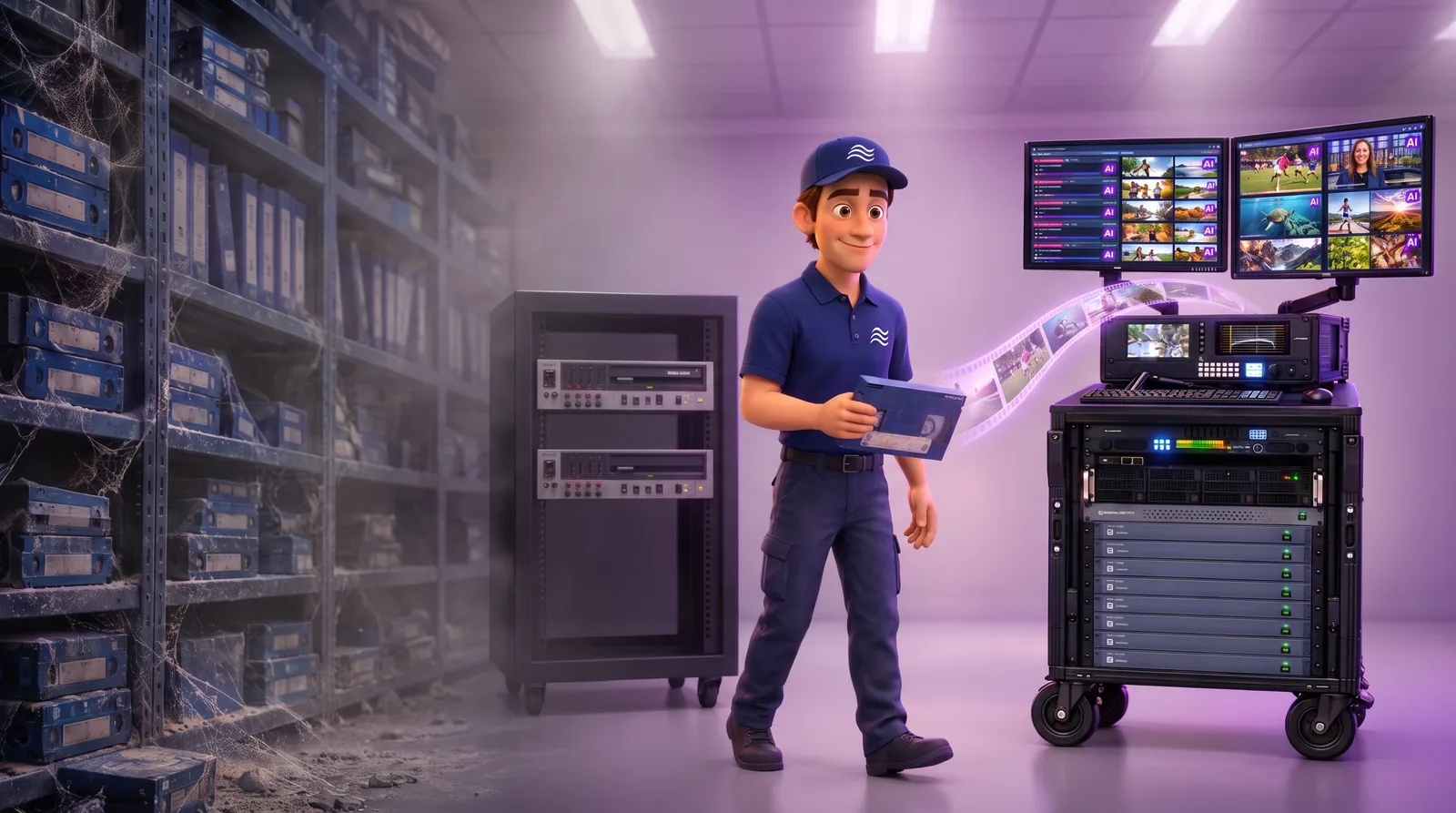
What each tape produces
Each tape is played once, because in most cases that is the only pass it will ever get. From that pass we produce:
- A working fileIn the broadcast format you already use.
- A lightweight viewing copyFor search and browsing.
Formats are matched to your existing systems.
Cleaning and treatment before playback
Non-metal tape and any tape with visible damage are cleaned and dehydrated before playback, so a tape that may not survive a second play is captured on the first.
Formats and decks
The system captures from any tape format that still has a working player, and it needs no separate correction equipment. What it can capture depends on which decks are available. We own and ship players for the common broadcast formats and source rarer ones as the collection requires.
Throughput and scale
Large collections can run several FlyPacks in parallel. Planning starts with which tapes to migrate first.
What a deployment needs
| Equipment | A single FlyPack rack on wheels, roughly the size of a large filing cabinet |
|---|---|
| Space | About nine feet square |
| Power | Three dedicated 20-amp circuits |
| Network | A connection to wherever the files will live |
| Noise | Server-room levels. In an occupied room we plan for separation or sound treatment. |
| Lead time | Five to seven weeks from order, including shipping and customs |
| Start-up | About a week from delivery to trained operators and first capture |
After capture
Migrated files can be indexed with on-premises AI, so speech, people, places, logos, on-screen text and scenes become searchable in your own library. See AI indexing for media archives. For where the files live and how they are protected, see Security and data control. If part of your archive is on data tape, see data tape migration.
Questions
Do our tapes have to leave the building?
No. The FlyPack is installed in your facility and runs there for the length of the project.
How many hours of tape can one system migrate?
5,000 tape hours a month per FlyPack. More FlyPacks can run in parallel.
Which tape formats can you migrate?
Any format that still has a working player. We bring the decks.
What files do we get back?
A working file in the broadcast format you already use, and a lightweight viewing copy for search and browsing.
How long until capture starts?
Five to seven weeks from order, including shipping and customs, then about a week from delivery to trained operators and first capture.
What about damaged or sticky tapes?
Non-metal tapes and any tape showing visible damage are cleaned and dehydrated before playback, so the one pass succeeds.
Tell us your tape formats and counts in the Free Archive Assessment, and we will scope the deck mix, the number of FlyPacks and the schedule.